
18
Apr
7:57 UTC
Syria SITUATION UPDATE: Syrian Arab Army (SAA) takes full control of Damascus’ East Ghouta region
Executive Summary
- Thee SAA’s successful termination of the East Ghouta offensive on April 12 is significant as it will allow the SAA to divert manpower and resources to other fronts.
- The SAA’s advances in southeastern Hama’s Rastan pocket in April was likely facilitated by the abovementioned development; however, the SAA remains likely to prefer evacuation deals with rebels over the launch of large-scale offensives in the region.
- The successful Islamic State (IS) offensive against the SAA in southeastern Homs Province on April 13 shows the group’s remaining operational capabilities in the region, and was likely facilitated by the redeployment of Syrian Arab Air Force (SAAF) jets to western Syria on April 11; IS is unlikely to defend the gains over the long-term.
- We assess that the SAA’s clearing of Damascus’ East Ghouta region will enable the pro-government forces to launch large-scale operations against their adversaries on other fronts over the coming weeks. A particular priority over the short term likely lies in fully securing the Damascus area in the short term. Moreover, the SAA has now fully secured the M5 Highway, which connects Damascus to Homs, Hama, and Idlib provinces. Thus, it remains likely that pro-government forces will also intensify their ongoing anti-rebel operations in northern Hama and Idlib provinces over the coming months.
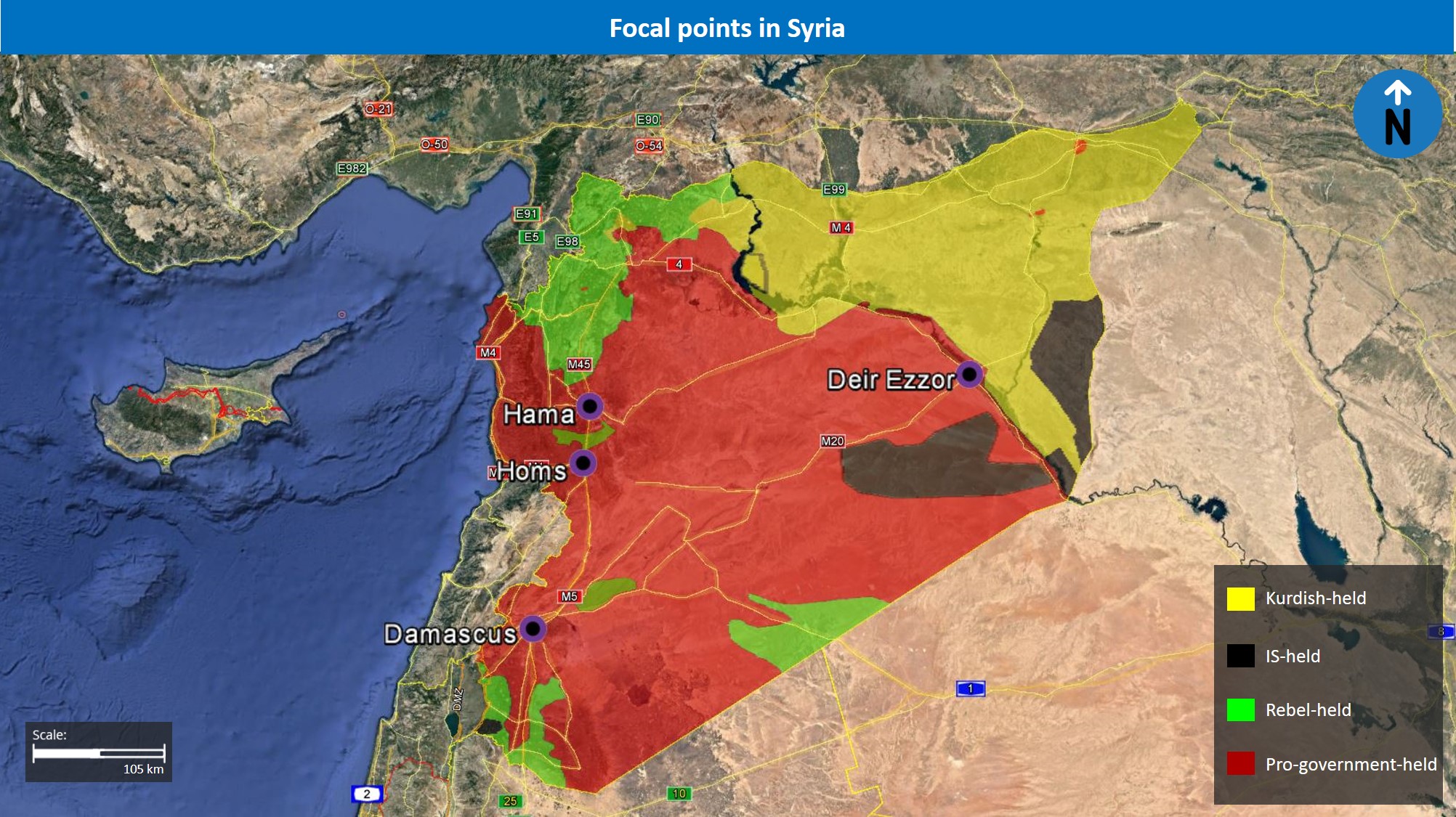
Current Situation
Across the country, the following incidents have been reported:
Damascus
| Map # | Date | District/City | Brief Description |
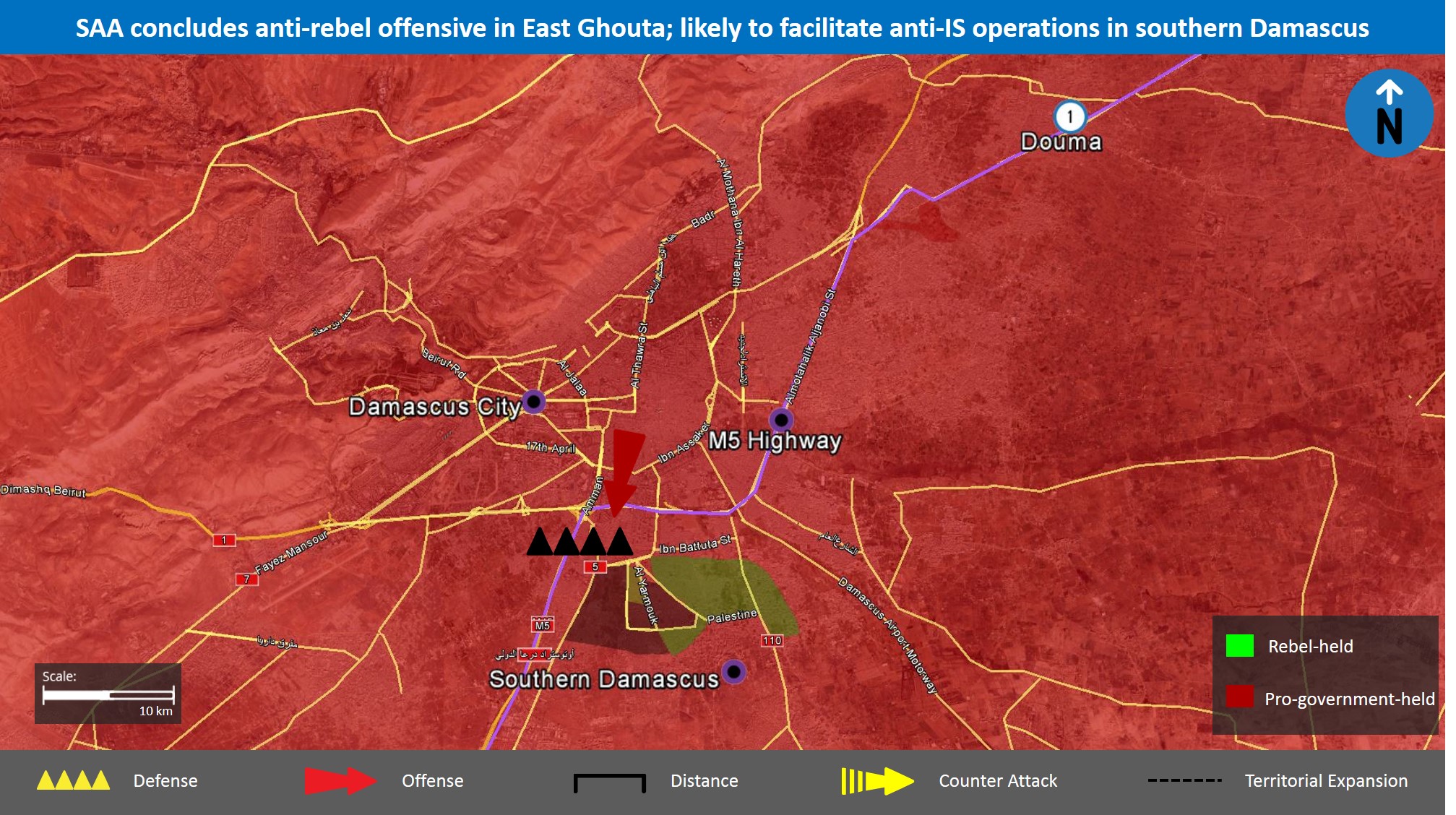
| 1 | April 12 | East Ghouta | The SAA takes full control of East Ghouta after Jaysh al-Islam rebel group surrendered its heavy weapons and left their stronghold of Douma |
| 1 | April 14 | Military facilities in Damascus area | The US, UK, and France strike military government facilities in response to the suspected chemical attack against the town of Douma |
| 1 | April 17 | East Ghouta’s Douma | Two VBIEDs explode in Douma, killing and wounding multiple people |
Hama Province
| Map # | Date | District/City | Brief Description |
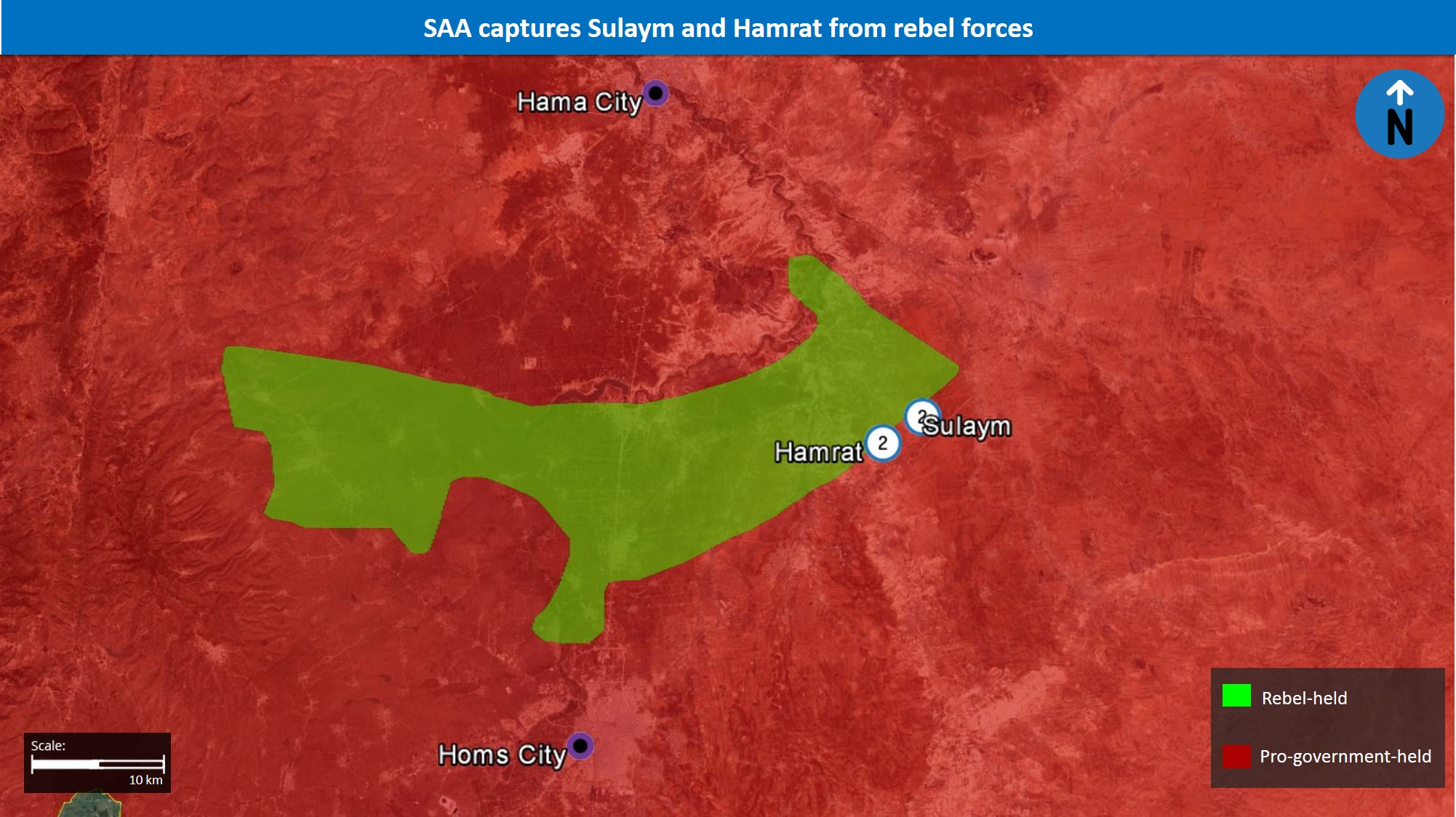
| 2 | April 15 | Sulaym, Hamrat | The SAA captures Sulaym and Hamrat after failed negotiations between the Syrian government and rebels regarding an evacuation deal in Hama Province |
Homs Province
| Date | District/City | Brief Description | |
| April 13 | Jabal Muhassah | IS launches a surprise assault on the SAA and takes control of several positions near Jabal Muhassah | |
| April 14 | Military facilities in Homs Province | The US, UK, and France strike military government facilities in response to the suspected chemical attack against the town of Douma |
Deir Ezzor Province
| Date | District/City | Brief Description | |
| April 14 | Mayadeen area | IS militants fire mortar shells and carry out an armed assault against pro-government positions. At least seven IS militants were killed in the clashes |
Assessments
- The clearing of Damascus’ East Ghouta region by the SAA on April 12 follows the suspected chemical weapons attack by the Syrian government targeting Douma on April 7, which resulted in the killing of dozens of people. The attack likely compelled Jaysh al-Islam, which had previously rejected an evacuation agreement with the Syrian government in late March, to surrender and evacuate Douma. The development is not only a symbolic victory but also tactically and strategically significant for pro-government forces. The end of hostilities in Damascus’ eastern countryside will allow the SAA to divert troops and assets to southern Damascus, where both IS and Islamist rebels maintain a pocket of control. Moreover, by capturing Douma, the SAA has effectively secured the M5 Highway, which connects Damascus to Homs, Hama, and Idlib provinces. This will facilitate the SAA’s ongoing offensives against rebels in northern Hama and Idlib provinces as it will allow them to transfer supplies, weapons, and troops from Damascus to these regions.
- Meanwhile, the SAA’s seizure of Sulayma and Hamrat on April 15 comes amidst a recent uptick in fighting between the parties in southern Hama’s rebel-controlled Rastan pocket. On April 2-3, the SAA took control over six towns in the vicinity of Sulaym and Hamrat as rebels withdrew from the former. The increased focus of SAA forces on Rastan is likely a result of the completed anti-rebel offensive in Damascus’ East Ghouta, which has allowed them to transfer troops to southern Hama. However, as highlighted by the aforementioned negotiations, we assess that the Syrian government is attempting to take control over the Rastan pocket by reaching evacuation deals and save resources by eschewing a large-scale offensive. However, as highlighted by the aforementioned failure of the negotiations, a sizable segment of the rebels will likely refuse to surrender. Thus, heavy fighting in the region will persist over the coming days, with further SAA advances likely to occur.
- Finally, the IS surprise assault on SAA forces around Jabal Muhassah on April 13 highlights the Sunni jihadist militant group’s remaining operational capabilities in southeastern Homs, despite the lack of nearby territorial footholds. This demonstrates that the group continues to maintain effective local cells in government-held territory, particularly southeastern Homs’ sparsely populated Badia desert region. The current assault was likely facilitated by the reported redeployment of Syrian Arab Air Force (SAAF) jets and helicopters to Russian bases in Latakia and Tartus on April 11. These measures, implemented in anticipation of potential US airstrikes against military facilities across Syria, have likely impeded immediate SAAF airstrikes on the attackers. However, following the aforementioned April 14 materialization of these strikes, we assess that the SAAF will redeploy their assets to bases across Syria over the coming days, and possibly target IS around Jabal Muhassah. In any case, given the complete isolation of IS in southeastern Homs, it remains unlikely that the latter will be able to defend their achieved gains over the long-term.
Recommendations
- We advise against all travel to Damascus and Aleppo, given the general threat of indiscriminate aerial bombardment and artillery shelling from government forces as well as attacks by various militant groups. Attacks by rebel forces may include the use of rocket-propelled grenades, suicide bombings, and mortar attacks.
- Those remaining in Damascus should ensure that contingency and emergency evacuation plans are updated due to the potential for a further deterioration in the security situation. Additionally, those remaining in Damascus are advised to avoid all travel to outlying areas of the city given the persistent threat of militancy.
- Those continuing to operate or reside in Aleppo are advised to minimize movement in the city and its surroundings, given the frequency and broad nature of fighting in the city.
- Avoid all travel to outlying areas and cities including Homs, Hama, and Idlib due to persistent fighting and heightened risk of kidnapping targeting foreigners, particularly in combat zones and rebel-held area.
COUNTRY RISK LEVEL
Extreme
AFFECTED AREA
Damascus, Hama, Homs and Deir Ezzor Provinces
INCIDENT RISK LEVEL
Extreme
STRENGTH OF SOURCE
Credible
Executive Summary
- Thee SAA’s successful termination of the East Ghouta offensive on April 12 is significant as it will allow the SAA to divert manpower and resources to other fronts.
- The SAA’s advances in southeastern Hama’s Rastan pocket in April was likely facilitated by the abovementioned development; however, the SAA remains likely to prefer evacuation deals with rebels over the launch of large-scale offensives in the region.
- The successful Islamic State (IS) offensive against the SAA in southeastern Homs Province on April 13 shows the group’s remaining operational capabilities in the region, and was likely facilitated by the redeployment of Syrian Arab Air Force (SAAF) jets to western Syria on April 11; IS is unlikely to defend the gains over the long-term.
- We assess that the SAA’s clearing of Damascus’ East Ghouta region will enable the pro-government forces to launch large-scale operations against their adversaries on other fronts over the coming weeks. A particular priority over the short term likely lies in fully securing the Damascus area in the short term. Moreover, the SAA has now fully secured the M5 Highway, which connects Damascus to Homs, Hama, and Idlib provinces. Thus, it remains likely that pro-government forces will also intensify their ongoing anti-rebel operations in northern Hama and Idlib provinces over the coming months.
Current Situation
Across the country, the following incidents have been reported:
Damascus
| Map # | Date | District/City | Brief Description |
| 1 | April 12 | East Ghouta | The SAA takes full control of East Ghouta after Jaysh al-Islam rebel group surrendered its heavy weapons and left their stronghold of Douma |
| 1 | April 14 | Military facilities in Damascus area | The US, UK, and France strike military government facilities in response to the suspected chemical attack against the town of Douma |
| 1 | April 17 | East Ghouta’s Douma | Two VBIEDs explode in Douma, killing and wounding multiple people |
Hama Province
| Map # | Date | District/City | Brief Description |
| 2 | April 15 | Sulaym, Hamrat | The SAA captures Sulaym and Hamrat after failed negotiations between the Syrian government and rebels regarding an evacuation deal in Hama Province |
Homs Province
| Date | District/City | Brief Description | |
| April 13 | Jabal Muhassah | IS launches a surprise assault on the SAA and takes control of several positions near Jabal Muhassah | |
| April 14 | Military facilities in Homs Province | The US, UK, and France strike military government facilities in response to the suspected chemical attack against the town of Douma |
Deir Ezzor Province
| Date | District/City | Brief Description | |
| April 14 | Mayadeen area | IS militants fire mortar shells and carry out an armed assault against pro-government positions. At least seven IS militants were killed in the clashes |
Assessments
- The clearing of Damascus’ East Ghouta region by the SAA on April 12 follows the suspected chemical weapons attack by the Syrian government targeting Douma on April 7, which resulted in the killing of dozens of people. The attack likely compelled Jaysh al-Islam, which had previously rejected an evacuation agreement with the Syrian government in late March, to surrender and evacuate Douma. The development is not only a symbolic victory but also tactically and strategically significant for pro-government forces. The end of hostilities in Damascus’ eastern countryside will allow the SAA to divert troops and assets to southern Damascus, where both IS and Islamist rebels maintain a pocket of control. Moreover, by capturing Douma, the SAA has effectively secured the M5 Highway, which connects Damascus to Homs, Hama, and Idlib provinces. This will facilitate the SAA’s ongoing offensives against rebels in northern Hama and Idlib provinces as it will allow them to transfer supplies, weapons, and troops from Damascus to these regions.
- Meanwhile, the SAA’s seizure of Sulayma and Hamrat on April 15 comes amidst a recent uptick in fighting between the parties in southern Hama’s rebel-controlled Rastan pocket. On April 2-3, the SAA took control over six towns in the vicinity of Sulaym and Hamrat as rebels withdrew from the former. The increased focus of SAA forces on Rastan is likely a result of the completed anti-rebel offensive in Damascus’ East Ghouta, which has allowed them to transfer troops to southern Hama. However, as highlighted by the aforementioned negotiations, we assess that the Syrian government is attempting to take control over the Rastan pocket by reaching evacuation deals and save resources by eschewing a large-scale offensive. However, as highlighted by the aforementioned failure of the negotiations, a sizable segment of the rebels will likely refuse to surrender. Thus, heavy fighting in the region will persist over the coming days, with further SAA advances likely to occur.
- Finally, the IS surprise assault on SAA forces around Jabal Muhassah on April 13 highlights the Sunni jihadist militant group’s remaining operational capabilities in southeastern Homs, despite the lack of nearby territorial footholds. This demonstrates that the group continues to maintain effective local cells in government-held territory, particularly southeastern Homs’ sparsely populated Badia desert region. The current assault was likely facilitated by the reported redeployment of Syrian Arab Air Force (SAAF) jets and helicopters to Russian bases in Latakia and Tartus on April 11. These measures, implemented in anticipation of potential US airstrikes against military facilities across Syria, have likely impeded immediate SAAF airstrikes on the attackers. However, following the aforementioned April 14 materialization of these strikes, we assess that the SAAF will redeploy their assets to bases across Syria over the coming days, and possibly target IS around Jabal Muhassah. In any case, given the complete isolation of IS in southeastern Homs, it remains unlikely that the latter will be able to defend their achieved gains over the long-term.
Recommendations
- We advise against all travel to Damascus and Aleppo, given the general threat of indiscriminate aerial bombardment and artillery shelling from government forces as well as attacks by various militant groups. Attacks by rebel forces may include the use of rocket-propelled grenades, suicide bombings, and mortar attacks.
- Those remaining in Damascus should ensure that contingency and emergency evacuation plans are updated due to the potential for a further deterioration in the security situation. Additionally, those remaining in Damascus are advised to avoid all travel to outlying areas of the city given the persistent threat of militancy.
- Those continuing to operate or reside in Aleppo are advised to minimize movement in the city and its surroundings, given the frequency and broad nature of fighting in the city.
- Avoid all travel to outlying areas and cities including Homs, Hama, and Idlib due to persistent fighting and heightened risk of kidnapping targeting foreigners, particularly in combat zones and rebel-held area.
COUNTRY RISK LEVEL
Extreme
AFFECTED AREA
Damascus, Hama, Homs and Deir Ezzor Provinces
INCIDENT RISK LEVEL
Extreme
STRENGTH OF SOURCE
Credible
Related Reports
Syria
-
 Armed ConflictSyria SITUATION UPDATE: SAA reportedly on high alert due to potential US airstrikes; US-led military response likely in coming days
 -
Armed ConflictSyria SITUATION UPDATE: Two US-led coalition soldiers killed, five wounded in March 29 IED explosion in Manbij; likely highly symbolic achievement for IS
-
Armed ConflictSyria SITUATION UPDATE: Syrian government troops make further advances in East Ghouta area on March 26
-
Armed ConflictSyria SITUATION UPDATE: Turkish-backed forces capture Afrin City from Kurdish elements on March 18
Related Reports
Syria
-
Armed ConflictSyria SITUATION UPDATE: SAA reportedly on high alert due to potential US airstrikes; US-led military response likely in coming days
-
Armed ConflictSyria SITUATION UPDATE: Two US-led coalition soldiers killed, five wounded in March 29 IED explosion in Manbij; likely highly symbolic achievement for IS
-
Armed ConflictSyria SITUATION UPDATE: Syrian government troops make further advances in East Ghouta area on March 26
-
Armed ConflictSyria SITUATION UPDATE: Turkish-backed forces capture Afrin City from Kurdish elements on March 18